
How better energy data can support businesses working towards stronger environmental management and energy efficiency
ISO 14001 and ESOS place different requirements on businesses, but both can expose the same underlying weakness: poor visibility of how energy is actually being used.
Most organisations can account for their total energy consumption. They know what they spend, they receive regular bills and they may already have half-hourly data or historic usage reports.
What is often less clear is where avoidable waste is occurring within the operation itself.
That distinction matters because annual consumption figures can show that energy has been used, but they do not always explain what caused it. A business may know that electricity use rose during a particular month without being able to identify whether the increase came from HVAC, production equipment, refrigeration, lighting or changes in operating hours.
For organisations working towards stronger environmental management, this lack of detail can make improvement harder than it needs to be.
ISO 14001 and ESOS have different purposes
ISO 14001 provides a framework for organisations to manage their environmental responsibilities and improve environmental performance over time.
ESOS is a separate UK scheme that requires qualifying organisations to assess their energy use and identify energy-saving opportunities.
Enerwise does not provide ISO 14001 certification, ISO consultancy or ESOS compliance services. It does not act as an ESOS lead assessor.
The relevance of Enerwise sits elsewhere.
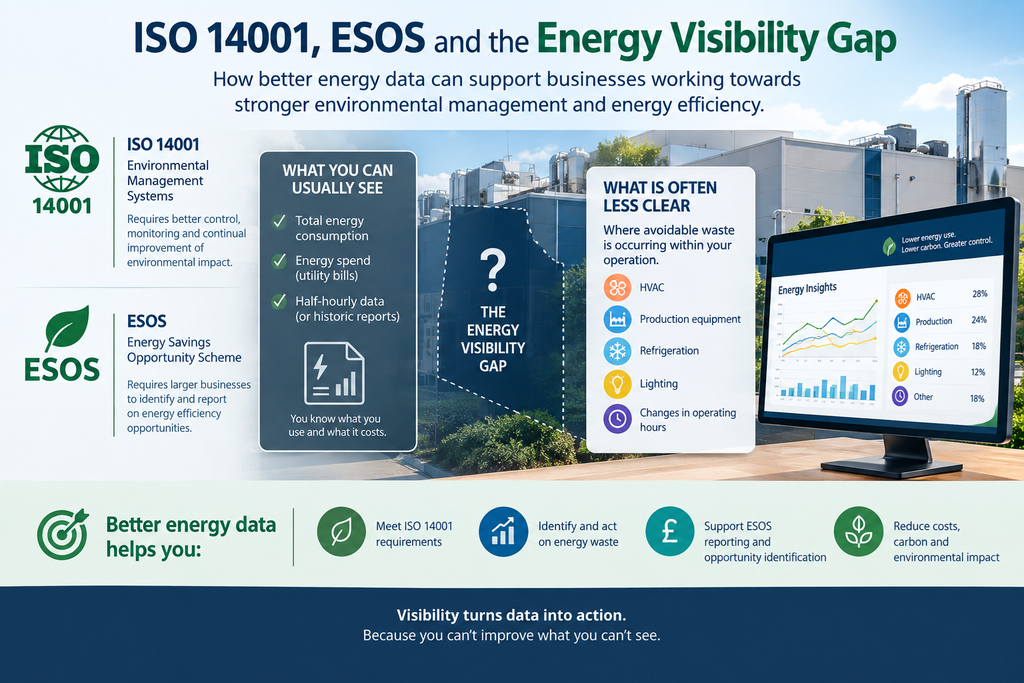
Businesses already engaged in these areas may find that they need better information about how energy is being consumed across their sites, processes and equipment. That is where energy monitoring and targeting can become useful.
Energy data is only useful if it helps explain what is happening
A monthly bill provides a financial record. Half-hourly data can provide a broader pattern.
Neither will necessarily show why a particular item of equipment is using more energy than expected, whether plant is operating outside required hours, or whether a previous efficiency measure is still delivering the expected result.
This is where many organisations encounter a practical gap.
Energy waste is often operational. Equipment remains on longer than necessary. Heating and cooling schedules drift. Machinery operates inefficiently. Settings are changed and not reviewed. Loads increase gradually and become part of normal consumption.
These issues can be difficult to identify without more detailed monitoring.
Enerwise uses real-time monitoring technology that can provide visibility at both building and asset level, allowing businesses to understand more clearly where consumption is occurring and how operating patterns are changing.
Why this matters for environmental improvement
For businesses pursuing ISO 14001, the value of better energy data is practical.
Where energy use is a significant environmental consideration, more detailed information can help support decisions about where improvement activity should be focused. It can also make it easier to track whether changes continue to deliver the intended result.
The same applies to businesses going through ESOS.
An ESOS assessment may identify a number of energy-saving opportunities. The more clearly an organisation understands its actual energy behaviour, the easier it becomes to prioritise those opportunities and evaluate what happens after action is taken.
This does not replace the work of an environmental consultant, certification body or ESOS lead assessor.
It gives the organisation better operational information to work with.
The gap is often in the detail
Enerwise starts with a Gap Analysis because there is little value in assuming where the problem sits.
The first job is to understand the current position properly: how energy is being used, where there may be avoidable waste and whether the opportunity is large enough to justify going further.
Sometimes the answer is relatively straightforward. Operating times can be adjusted. Settings can be corrected. A process can be tightened up without major investment.
In other cases, the problem is that the site simply does not have enough visibility to know what is happening.
That is where more detailed monitoring becomes useful.
Asset-level data can show whether plant is running outside required hours, whether consumption is drifting and whether a particular system is behaving differently from normal. In a manufacturing environment, those changes can sit unnoticed for months because they are absorbed into the wider site load.
This is also where the wider Enerwise service becomes important. It is designed as a turnkey approach, taking a business from the initial discovery work through monitoring, control and optimisation, then into ongoing proactive energy management.
The monitoring identifies what is happening. Control technology can be introduced where it makes sense. Ongoing management then helps make sure improvements are maintained rather than gradually being lost as operating conditions change.
Keeping savings in place is often the harder part
Identifying an opportunity is one thing. Keeping the improvement in place six or twelve months later is often more difficult.
Sites are not static. Shift patterns move, maintenance work changes equipment behaviour, controls are adjusted and production requirements alter. A sensible change made in January may no longer be working in quite the same way by September.
That is why ongoing monitoring matters.
For facilities and engineering teams, the useful question is not just whether an improvement worked when it was introduced. It is whether it is still working now.
This is one of the reasons the potential savings can be significant. Customers can see reductions in the region of 15–30% on annual energy bills, depending on the site, its starting point and the opportunities identified.
The same data can also reveal changes that point to wider operational issues. A motor drawing more power than usual or a refrigeration system working harder than expected may deserve attention for reasons beyond the energy bill.
Those are useful by-products of having better visibility in the first place.
A practical question for businesses already doing the work
A useful starting point is to look beyond total consumption and ask how well the organisation understands the energy use underneath it.
- Can major energy-consuming assets be identified?
- Can unnecessary operation outside normal hours be seen?
- Can the impact of an efficiency measure be checked after implementation?
- Can unusual consumption be traced back to a particular process or piece of equipment?
If those questions are difficult to answer, there may be a gap in the organisation’s energy information.
Enerwise’s complimentary Gap Analysis is designed to establish whether that gap is significant enough to warrant action and where the most useful opportunities may sit.
From there, businesses can explore how Enerwise approaches energy efficiency, from detailed monitoring through to control and ongoing management where appropriate.
For businesses already investing time in ISO 14001, ESOS or wider environmental improvement, that can provide a much clearer operational picture before further decisions are made.